
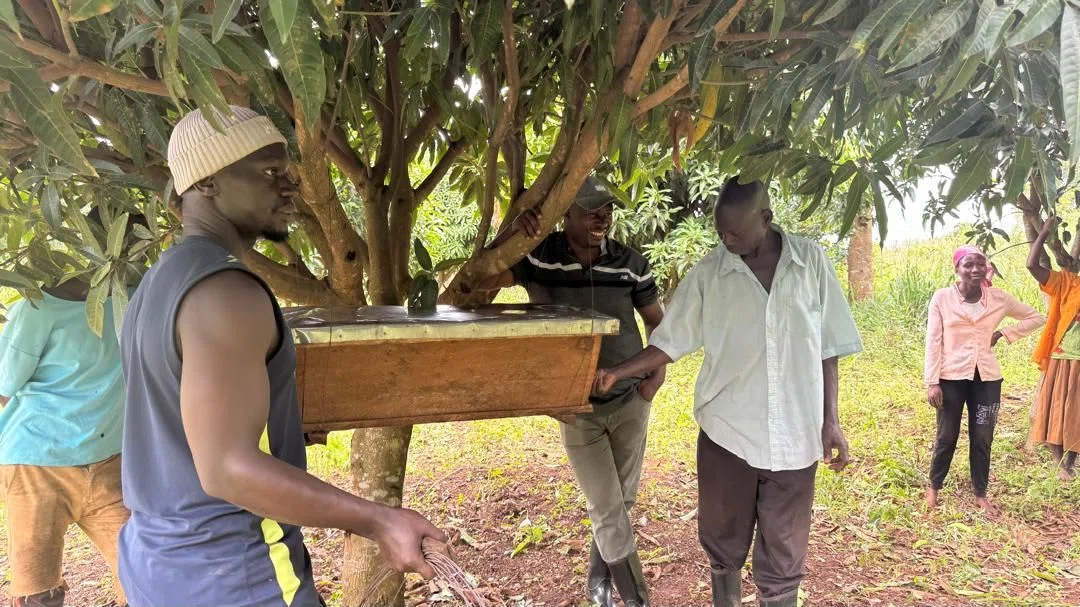
Beekeeping as a Living Shield: Fostering Human-Wildlife Coexistence in Masindi and Hoima
Chimpanzee Trust Field Conservation Team
Field Conservation & Community Program
In partnership with Uganda Biodiversity Fund and Kaakyo Home of Bee Products, Chimpanzee Trust has introduced 29 Kenya Top Bar beehives across Kasongoire, Bulyango, and Kasenene parishes as an innovative living buffer and sustainable livelihood solution.
In the agricultural parishes of Kasongoire, Bulyango, and Kasenene across Masindi and Hoima districts, human-wildlife encounters have long posed a delicate, everyday challenge for surrounding farming communities. Expanding agricultural boundaries alongside sensitive forest reserves have strained local relations with wild animals, requiring thoughtful, community-driven interventions.
Seeking a sustainable solution that safeguards both household livelihoods and vital wildlife habitats, the Chimpanzee Trust, in partnership with the Uganda Biodiversity Fund (UBF), has launched an innovative apiculture intervention across the three target parishes.
Hands-On Apiculture Training in the Field
The initiative has introduced 29 high-quality Kenya Top Bar (KTB) beehives to serve as active demonstration sites across local communities. Led by apiculture experts from Kaakyo Home of Bee Products, local farmers participated in intensive, hands-on training sessions covering essential field techniques.
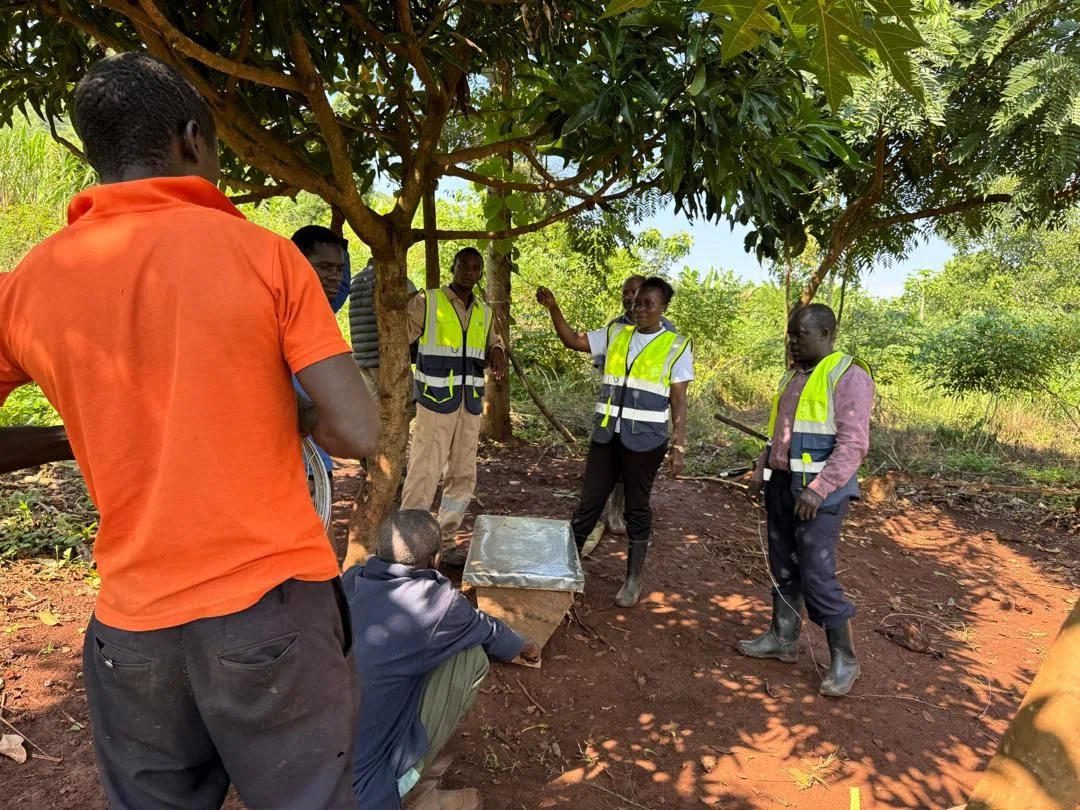
Field demonstration led by Kaakyo Home of Bee Products guiding community members through apiculture fundamentals.
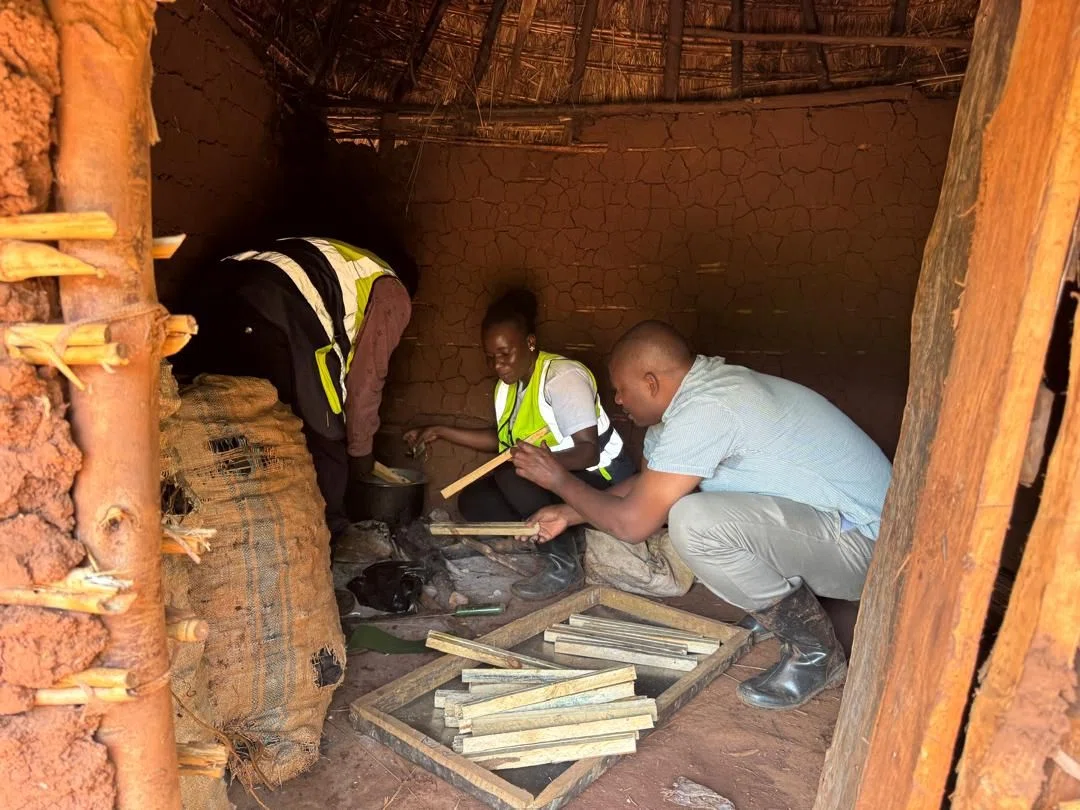
Baiting top bars using natural beeswax and fresh lemongrass to attract passing wild bee swarms.
A crowd of local farmers gathered at the demonstration apiaries, watching intently as trainers demonstrated how to bait top bars using natural beeswax and fresh lemongrass to lure passing wild swarms. Practical guidance covered optimizing hive height—suspending hives safely one meter above the ground between mature trees—and adjusting sun orientation to accelerate natural colonization while protecting the bees from ground predators.
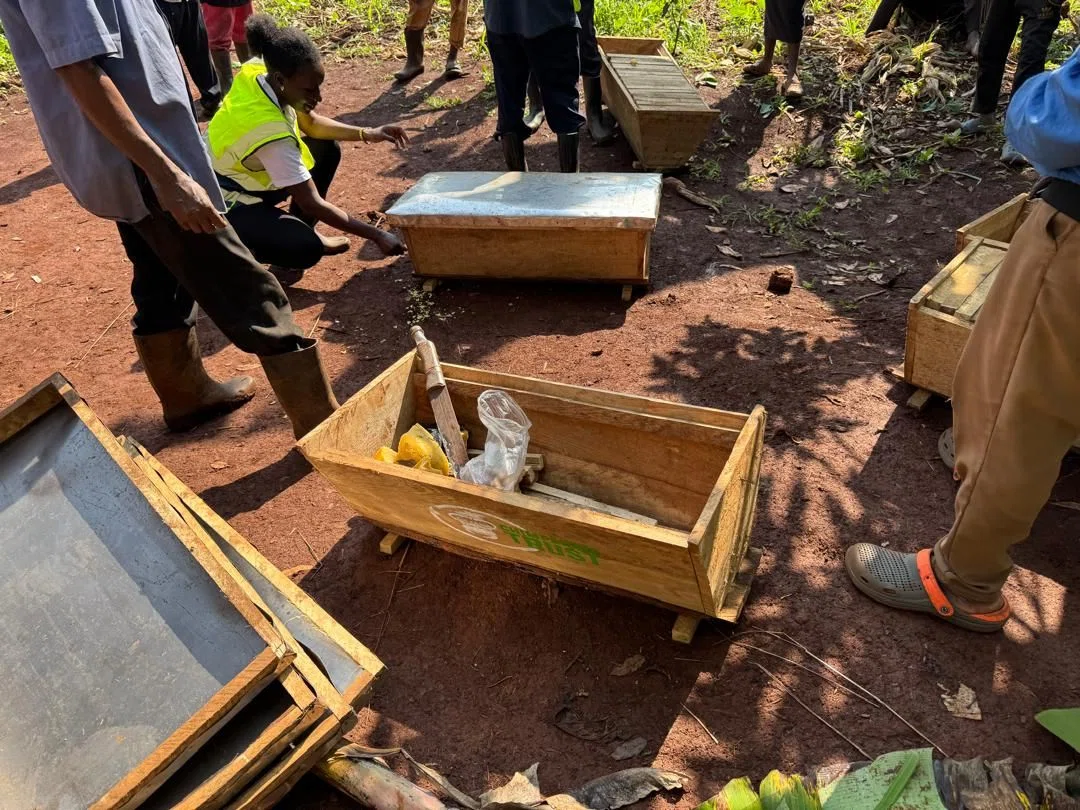
Farmers assemble Kenya Top Bar hives with durable local materials suited for long-term field use.
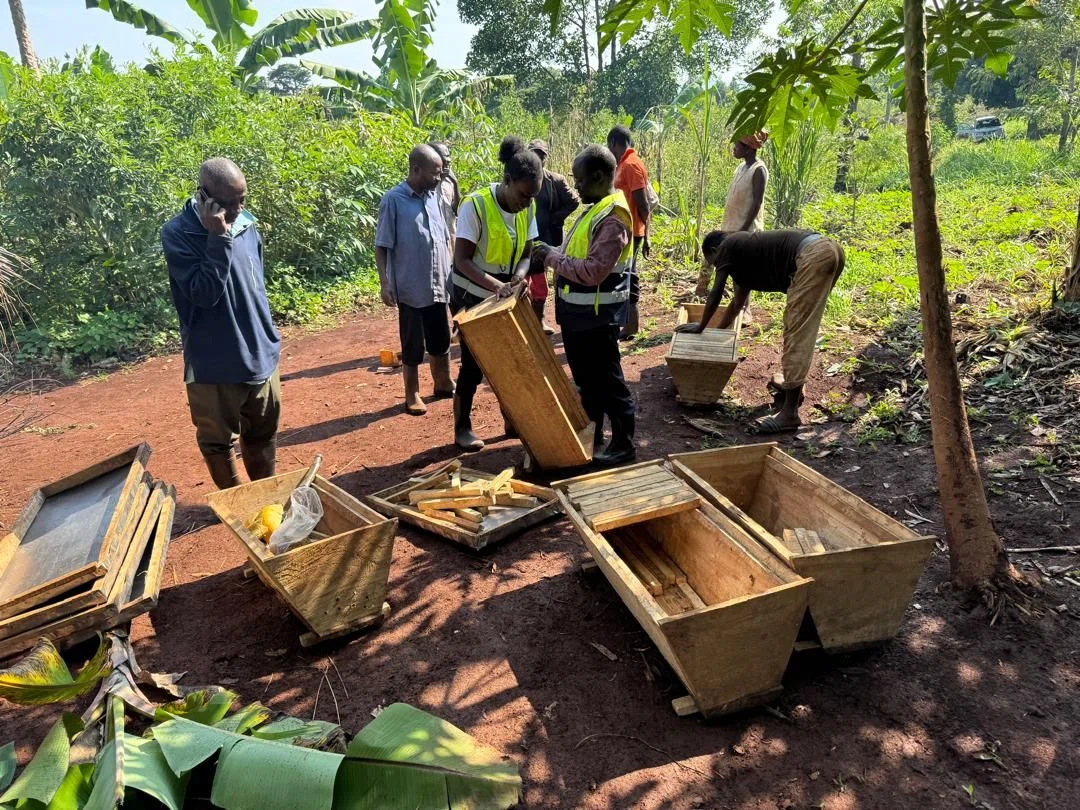
Community collaboration: local farmers learning swarm management and hive construction together.
A Living Shield Between Farms and Forest
What began as twenty-nine wooden hives suspended along the boundary line has evolved into a strategic ecological buffer. The demonstration apiaries scattered across Kasongoire, Kasenene, and Bulyango serve as hubs of regular communal activity where farmers meet to observe colonization progress and practice swarm management.
Crucially, these suspended apiaries function as a living shield between agricultural croplands and adjacent forest reserves. Wild animals, including chimpanzees and baboons, naturally avoid active beehives, making the apiary lines an effective, non-violent barrier that minimizes crop-raiding incidents without harming wildlife.
Dual Economic and Ecological Dividends
The intervention delivers tangible benefits on two fronts:
- Economic Diversification: The hives provide community households with regular harvests of pure organic honey, valuable beeswax, propolis, and other bee products. These create stable, high-value income streams that supplement traditional subsistence farming.
- Habitat Protection: By establishing a productive buffer along the forest boundary, farmers harvest high-value forest products without entering, clearing, or disturbing the core natural habitat.
- Community Mentorship: Demonstration farmers now act as peer ambassadors, mentoring neighboring households and encouraging wider adoption of sustainable apiculture throughout the Bunyoro landscape.
Project Summary & Partners
Target Locations: Kasongoire, Bulyango, and Kasenene Parishes (Masindi & Hoima Districts)
Intervention: 29 Kenya Top Bar (KTB) Demonstration Beehives
Corridor: Budongo-Mukihani-Kasongoire Ecological Landscape
Lead Implementer: Chimpanzee Sanctuary & Wildlife Conservation Trust
Funding Partner: Uganda Biodiversity Fund (UBF)
Apiculture Technical Partner: Kaakyo Home of Bee Products
By turning a persistent source of human-wildlife tension into a shared opportunity for local prosperity, this initiative proves that nature conservation and community well-being naturally reinforce each other. Through this balanced approach, we continue safeguarding vital forest corridors, empowering local families, and cultivating lasting coexistence between people and primates.
Chimpanzee Sanctuary & Wildlife Conservation Trust — Partners in the welfare of wildlife and community coexistence.
For more information on our field programs, visit our Field Conservation Program and Human Wildlife Conflict Mitigation pages.

